



Advanced Ceramic Material Expert
Advanced Ceramic Material Expert

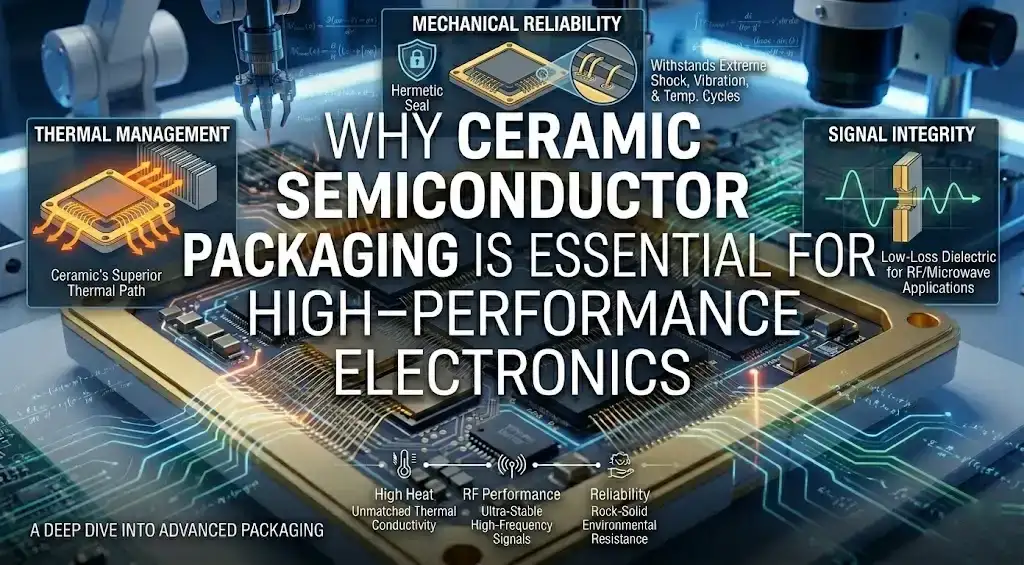
Semiconductor packaging is the foundation that determines whether a chip succeeds or fails in real-world applications. Even the most advanced silicon die will fail without proper packaging to provide structural support, manage heat dissipation, and maintain electrical integrity. The wrong package choice leads to overheating, signal degradation, and premature mechanical failure.
In today’s demanding applications, high-frequency RF modules, high-voltage power electronics, and mission-critical systems in automotive, aerospace, and medical devices, ceramic packaging is not just a material choice. It is a strategic decision that directly impacts performance and long-term reliability. The cost of failure in these sectors is too high to leave packaging decisions to chance.
Ceramic semiconductor packaging usually means chip enclosures manufactured using advanced ceramic materials instead of traditional plastic or metal housings. These packages serve multiple purposes: they protect the die, improve electrical connectivity and manage heat for peak operational performance.
Ceramic packages outperform plastic alternatives with higher thermal conductivity and superior dielectric strength. Compared to metal packaging, ceramics offer better electrical insulation while maintaining excellent structural integrity under thermal stress.
Common ceramic materials used for packaging include alumina and aluminum nitride. These are preferred in the industrial sector for their thermal management capabilities and electrical insulation properties. Aluminum nitride, in particular, stands out when your application demands aggressive heat dissipation.
Ceramic packages come in several standard configurations: dual in-line packages (DIPs), quad flat no-lead (QFN) formats, leadless chip carriers (LCCs), and hybrid assemblies. Each design is tailored for specific thermal, electrical, and mechanical requirements to ensure optimal device performance.
Ceramic packaging is standard in aerospace, automotive electronics, medical devices, telecommunications, and defense systems. In these fields, device failure is not merely inconvenient, it is unacceptable. The reliability that ceramic packaging provides directly translates to system-level performance and safety.
When you design high-power modules or RF devices, heat becomes your primary adversary. Excess heat takes a toll on parts and accelerates degradation. It is also responsible for shifts in electrical characteristics and triggers thermal runaway.
Ceramic materials, particularly aluminum nitride, conduct heat away from the die far more efficiently than plastic. This active heat dissipation stabilizes junction temperatures and protects sensitive components from thermal cycling stress. In power electronics for electric vehicles or renewable energy systems, superior heat management directly translates to system reliability and extended service life.
High-voltage applications need materials with strong dielectric properties for flawless operation. Ceramic semiconductor packages deliver that high dielectric strength. The result is that current leakage is non-existent and stable insulation even under elevated voltages and temperatures.
In power electronics and RF systems, electrical isolation must remain constant over time. Ceramic materials deliver that consistency because they do not soften, deform, or degrade like plastic when exposed to continuous electrical stress.
Thermal cycling destroys weak materials. This is because the expansion and contraction create internal stress that leads to cracks and bond failures.
Ceramics resist this kind of stress easily. Their dimensional stability means that the structural integrity is sustained during repeated temperature fluctuation. In automotive under-hood environments or aerospace systems exposed to extreme altitude variations, this stability preserves interconnections and solder joints. Reliability is engineered. Not assumed.
Moisture and contaminants that kill the performance of any technology product. Ceramic packages can be hermetically sealed, forming airtight enclosures that shield the die from humidity, chemicals, and environmental pollutants.
This sealing capability becomes crucial in defense electronics, implantable medical devices, and satellite systems applications. Exposure to moisture in these applications can cause corrosion, short circuits, and premature failure. Hermetic ceramic packaging ensures long-term operational integrity in environments where replacement is impossible or prohibitively expensive.
Ceramic packaging does not achieve its performance advantages by material choice alone. Precision assembly is another aspect that matters a lot in making the benefits materialize during performance.
Precision assembly mainly centers on correct installation of the ceramic packaging. That means advanced bonding and die-attach processes for secure attachment. Wire bonding is another procedure that directly impacts conductivity, mechanical stability, and signal performance of the gadget. In high-frequency applications, using too much bonding material also negatively impacts performance.
The tools used in ceramic package assembly define the long-term durability and service life of the technological accessory. The capillary tool forms consistent ball-and-wedge bonds during wire bonding, ensuring uniform interconnections. Collets secure and accurately position delicate ceramic packages during die attach and bonding, preventing misalignment and mechanical stress. The Electronic Flame-Off wand generates precise free-air balls in gold wire bonding, creating reliable interconnections with controlled geometry.
When these tools operate with tight process control, gain consistent bond strength, stable electrical pathways, and improved production yield. When precision slips, defects multiply. The margin for error is thin.
When your application tolerates minimal stress and short lifecycles, plastic may suffice. When failure carries financial, safety, or reputational consequences, ceramic becomes non-negotiable.
Performance Factor |
Ceramic Packaging |
Plastic Packaging |
|
Thermal Control |
Moves heat fast. Keeps junctions stable under high load. |
Traps heat at high power. Performance drifts. |
|
Electrical Insulation |
Strong dielectric strength. Holds under high voltage. |
Adequate at low stress. Breaks down under extremes. |
|
Mechanical Stability |
Stays rigid through thermal cycling. Resists cracking. |
Expands. Warps. Fatigues over time. |
|
Environmental Protection |
Can be hermetically sealed. Blocks moisture and contaminants. |
Not airtight. Moisture gets in. |
|
Service Life |
Built for long missions and harsh duty. |
Designed for shorter lifecycles. |
|
Cost Logic |
Higher upfront cost. Lower failure risk. Strong lifecycle value. |
Lower entry cost. Higher long-term exposure. |
|
Strategic Fit |
Essential for aerospace, defense, medical, RF, and power electronics. |
Suited for consumer and low-stress devices. |
Ceramic packaging stabilizes high current modules and are highly efficient in heat load management and this becomes really useful in reliable operation of power electronics for electric vehicles and renewable energy systems. Without effective thermal dissipation, system efficiency collapses.
Ceramic packaging also ensures stability of signals in RF and microwave devices. Signal interference is non-negotiable in satellite communications and 5G infrastructure and ceramic packaging with its low dielectric variation protects frequency performance.
Another sector where ceramic packaging enhanced the functionality of products is the Military and aerospace. Technologies in these industries need hermetic sealing and structural resilience for seamless function. Most gadgets in these sectors are exposed to vibration-heavy and extreme temperature environments and to handle such an environment the ceramic packaging acts as a protective barrier safeguarding the semiconductor components inside.
Medical implants and diagnostic equipment require a combination of biocompatibility, hermetic sealing, and long-term reliability to function well and be considered high quality by the market. In such equipment, ceramic packaging becomes necessary in protecting sensitive electronics inside the human body, where failure is unacceptable.
AI is revolutionizing the semiconductor market and over the years the energy demand of AI hardware will only increase. That means more heat dissipation because more transistors will be attached in a smaller space. To dissipate this heat the use of ceramic semiconductor packaging will only increase.
Another recent development that increases the demand of ceramic semiconductor packaging is the growing use of wide bandgap semiconductors such as silicon carbide and gallium nitride. These semiconductors are different from traditional silicon semiconductors since they operate at higher voltages and temperatures. To handle that additional heat load ceramic semiconductor packaging becomes necessary.
Miniaturization trends further compress thermal margins. Smaller form factors leave less room for passive cooling solutions. Packaging must actively manage heat while maintaining mechanical and electrical integrity.
Ceramic materials will not replace every plastic package. But in high-performance domains, their role will expand steadily and strategically.
When you evaluate packaging, look beyond component cost. Measure risk. Assess lifecycle value. Consider operational stability over years, not months.
Ceramic semiconductor packaging delivers superior thermal management, electrical insulation, mechanical stability, and hermetic protection. It strengthens reliability in applications where performance margins are thin and consequences are severe.
If your electronics operate in demanding environments, ceramic packaging is not a luxury upgrade. It is foundational infrastructure.
Choose materials that protect your innovation. Choose packaging that earns its place in high-performance systems.
Spending cold nights is not possible without an HVAC system. But sometimes, one can face some situat...
READ FULLSemiconductor packaging is the foundation that determines whether a chip succeeds or fails in real-w...
READ FULLWe are proud to participate in GOACON 2026 in Gujarat, showcasing our Ceramic Femoral Head and Liner...
READ FULL